Founder, Designer & Developer · 2025-Present
Designing a Bespoke Wedding Website Studio
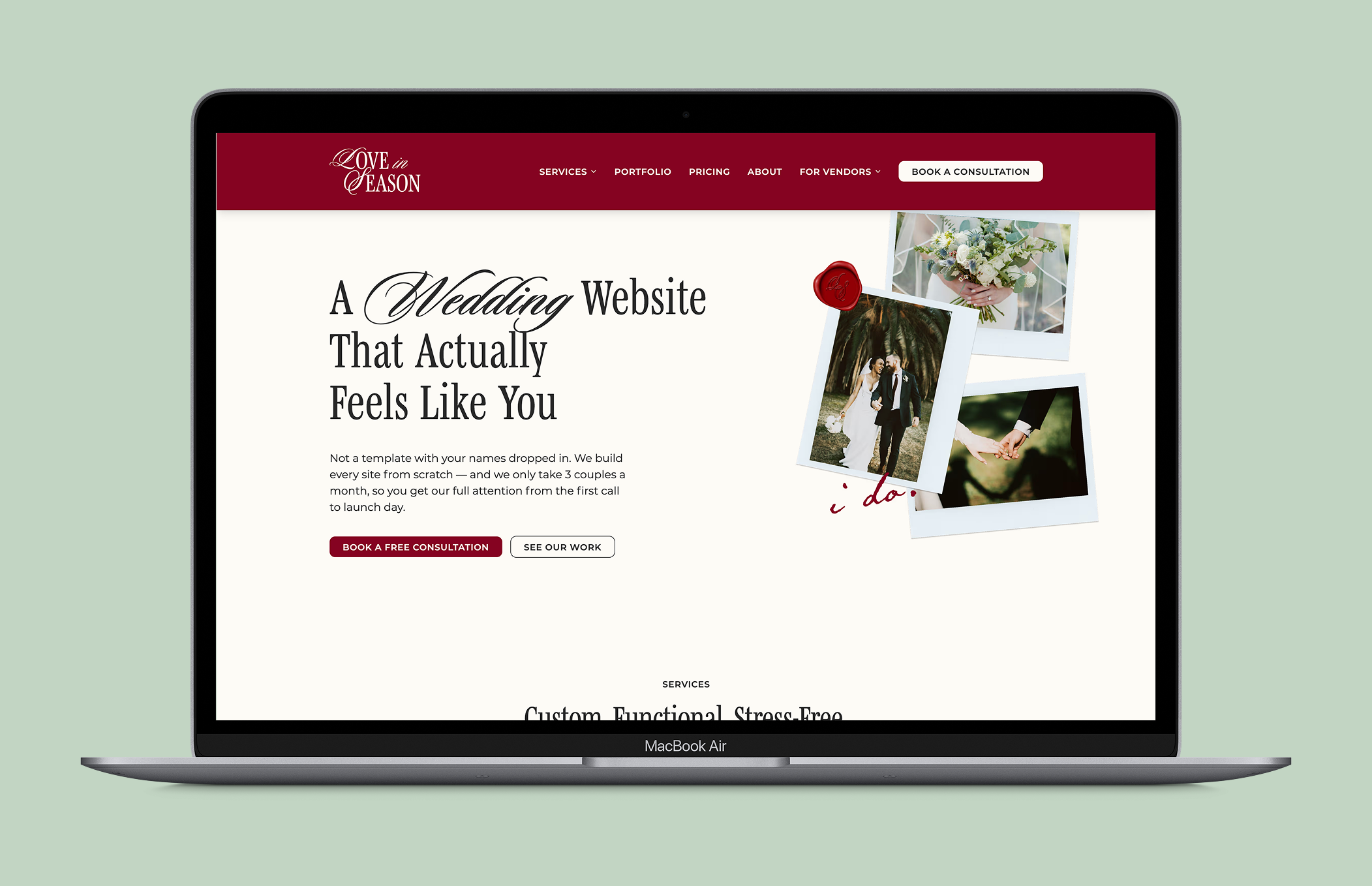
I saw a newly engaged woman complain online that she couldn't find a wedding website that actually felt like her. I founded Love in Season to fix that. I built the marketing site and designed and built the client-facing product, including a custom portal with real-time RSVP tracking, a couple-managed CMS, and event-filtered email blasts.
The Problem
The wedding website market has two options and neither works well for most couples. DIY tools like The Knot and Zola are affordable but the templates are generic, every couple ends up with something that looks like everyone else's. Custom agencies can build something truly personal, but they aren't trusted in the wedding space. The couples who fall in the middle have no good options. I saw this gap in a single complaint from a newly engaged woman online.
Discovery
- 01
Before building anything, I talked to couples directly over social media and spent time in wedding subreddits watching what people actually complained about. The consistent signal: it wasn't that DIY tools were hard to use, it was that the output looked the same as everyone else's. No one wants a generic wedding website! Couples had vision and aesthetic references, a clear sense of what felt like them, but the tools couldn't execute it or they didn't have the design or technical skills to do it. That told me the product wasn't a tool but actually a service.
- 02
Competitor research confirmed the gap, but it's a specific one. DIY tools top out at a certain aesthetic ceiling regardless of how much time you invest in them. The couples Love in Season is for already know what they want. They have Pinterest boards, aesthetic references, a clear vision. Couples with a vision with no time or skills to execute their dream wedding website.
- 03
I assumed the hardest part would be convincing couples the service was worth it. What I learned from talking to people is that timing is the real problem. Couples make this decision in a narrow window early in their engagement, before they default to a template. Missing that window messes up the whole wedding planning timeline.
Key Decisions
- ·
I defined 'bespoke' tightly from the start: a custom-designed website built on a proven stack, with a clear process and fixed timeline. The constraint is what makes the pricing viable and the promise credible. I wanted couples to know exactly what they're getting.
- ·
I built a tiered portal model where the feature set scales with the package. Tier 1 is RSVP-only, Tier 2 adds a couple-managed CMS and email blasts, Tier 3 adds SMS. The tiering wasn't about upselling but about not building complexity couples don't need. Different couples have different needs and I wanted to give them the right tool for their wedding, not a one-size-fits-all solution.
- ·
The portal was designed around one principle: couples should be able to manage their own day without coming back to me. They can update their schedule, FAQs, travel info, and wedding party content independently. Real-time RSVP updates are powered by Supabase realtime subscriptions so the couple sees guest responses the moment they come in, no refresh needed. Email blasts go out from their own address.
Outcome
Love in Season is up and running. I built a marketing website, a portfolio of sample projects showing different aesthetic directions, and a client portal. I am excited to continue working with couples to help them get the wedding website that actually feels like them.
Portal features
RSVP · CMS · Email · SMS
Sample projects
2

What I'd Do Differently
- ·
I validated the idea with only 3 couples before building. That was enough to confirm the pain point exists, but not enough to really understand what the buying decision looks like, who initiates it, when in the engagement it happens, what makes someone pull the trigger. I'd spend more time talking to a larger sample of couples to get to know a more complete picture of the decision-making process.
- ·
Distribution is harder than I expected. Building the product was the easy part. I assumed word-of-mouth would come quickly once the work was good enough, what I underestimated was how intentional you have to be about getting in front of couples at the right moment in their planning process.